
Grooming Needs of Big Dogs vs. Small Dogs: What's the Difference?
Big dogs and small dogs both need regular grooming, but their needs differ in time, tools, effort, and frequency. Small dogs tend to be more often groomed and handled since their bodies are more fragile, and large dogs are more physically demanding, more time consuming, and require heavy-duty tools to manage their greater surface areas and thicker undercoats. Understanding these differences ensures you provide the safest and most effective care for your pet.
Do big dogs and small dogs have different grooming requirements?
Yes, size plays a major role in how you approach grooming. Yes, the size is significant to the manner of grooming. Although the fundamentals such as washing, brushing, drying, and trimming of nails are common to all the dog breeds, the process varies.
Small dogs are known to possess growing fur, which needs accurate scissoring and grooming. They also have increased chances of dental problems, that is, their grooming process usually involves more intensive teeth cleaning. Because they are closer to the ground, they pick up debris more easily, necessitating frequent baths.
Large dogs present a different set of challenges. They are so large that bathing and drying will be much longer. Most of the big breeds (such as German Shepherds or Huskies) possess a double coat that sheds heavily and thus needs extensive
de-shedding sessions instead of the delicately trimmed hair cut found on a Poodle or a Yorkie. Different forms of restraints have to be used in handling a large dog as well to guarantee the safety of the dog and the groomer.
What are the specific grooming challenges for small dogs?
Grooming a small dog might seem easier due to less surface area, but they come with unique intricacies that require a gentle, patient hand.
1. Fragility and handling
Physical frailty is the most essential aspect of toy and small breeds. A fall on a grooming table or rough treatment may result in severe harm. Tracheal collapse is one of the most frequent problems among small dogs, such as Yorkies and Chihuahuas, which groomers should be very attentive to. It may be required to use a harness or special grooming loop, which does not exert pressure on the neck.
2. Dental health
Small dogs have clogged oral cavities that expose them to periodontal disease. Small breeds may require grooming that involves a good examination of teeth and gums. Although a groomer cannot substitute a veterinarian, having the hair around the mouth clean and checking whether the dog is showing signs of decay is a normal procedure of the small-dog schedule.
A lot of small breeds have silky hair which is easily tangled. When not combed every day, this hair may take tight mats near the skin. The mats may be difficult and dangerous to remove since the skin of small dogs is thinner and can easily tear as compared to those of large dogs.
Small dogs may be more anxious on the grooming table. They can be overwhelmed by the sound of the dryers or the feeling of being touched. They should be kept calm by patience and positive reinforcement.
What should I know about grooming large dogs?
Grooming a large dog is a marathon, not a sprint. It involves physical power, the right space and large-duty machines.
- Coat volume and shedding
The most difficult thing with large dogs is the quantity of hair. Newfoundlands, Golden Retrievers, and Bernese Mountain Dogs are breeds that possess dense double coats. In shedding season or "blowing coat" the amount of loose fur may be excessive. Grooming on a successful basis needs high-speed dryers, as well as special rakes that take away the dead undercoat without disturbing the topcoat.
- Joint health and comfort
Hip dysplasia or arthritis can also affect large dogs, particularly during old age. It is painful to stand long on a grooming table. It is essential to provide them with breaks or groom them in parts. Support slings or grooming on the floor (when safe) may be used to reduce the stress on their joints.
- Drying time
The most time consuming stage of the process is drying a big dog. When a thick coat is not thoroughly dried, moisture that is trapped against the skin may cause
hot spots and fungal infections. The large breeds cannot be compromised on high-velocity dryers to have the coat well dry down to the skin.
Large dogs have heavyweight, hard nails, which may be hard to trim. Without being regularly walked on pavements, these nails may become long quite fast, and this influences the dog's posture and walking style. They may require heavy-duty clippers or a Dremel tool to handle them.
How do tools differ for big vs. small dogs?
The instrument for a Chihuahua is quite unlike the one used for a St. Bernard. Improper use of a tool may be useless or even harmful.
For Small Dogs:
- Slicker brushes with soft pins: To avoid scratching delicate skin.
- Fine-toothed combs: For detailing face and ear furnishings.
- Small, quiet clippers: To reach tight areas like armpits and sanitary zones without startling the dog.
- Toothbrushes and finger brushes:
The right size to fit small mouths.
For Large Dogs:
- Undercoat rakes and de-shedding tools: These are necessary to remove loose fur on the double coats.
- High speed dryers: To blow water off of thick fur and accelerate the drying process.
- Heavy-duty nail clippers: Can cut through thick, calcified nails.
- Hydraulic lift grooming tables: To protect the back of the groomer, as well as safely lift the dog.
How often should I groom my dog based on size?
Frequency is more about the type of coats than the size, although the size helps in the kind of work that should be done between professional visits.
Small Dogs (Long/Silky Coats):
- Professional Grooming: Every 4–6 weeks.
- Home Maintenance: Daily brushing to prevent mats; frequent face wiping to prevent tear stains.
Large Dogs (Double Coats):
- Professional Grooming: Every 8–12 weeks is often sufficient for a full bath and blowout.
- Home Maintenance: Weekly brushing (daily during shedding season) to manage loose hair and distribute oils.
Large Dogs (Wire/Curly Coats):
- Professional Grooming: Every 6–8 weeks (like Poodles or Doodles) to prevent matting.
- Home Maintenance: Brushing 2–3 times a week.
Can I groom my big dog at home?
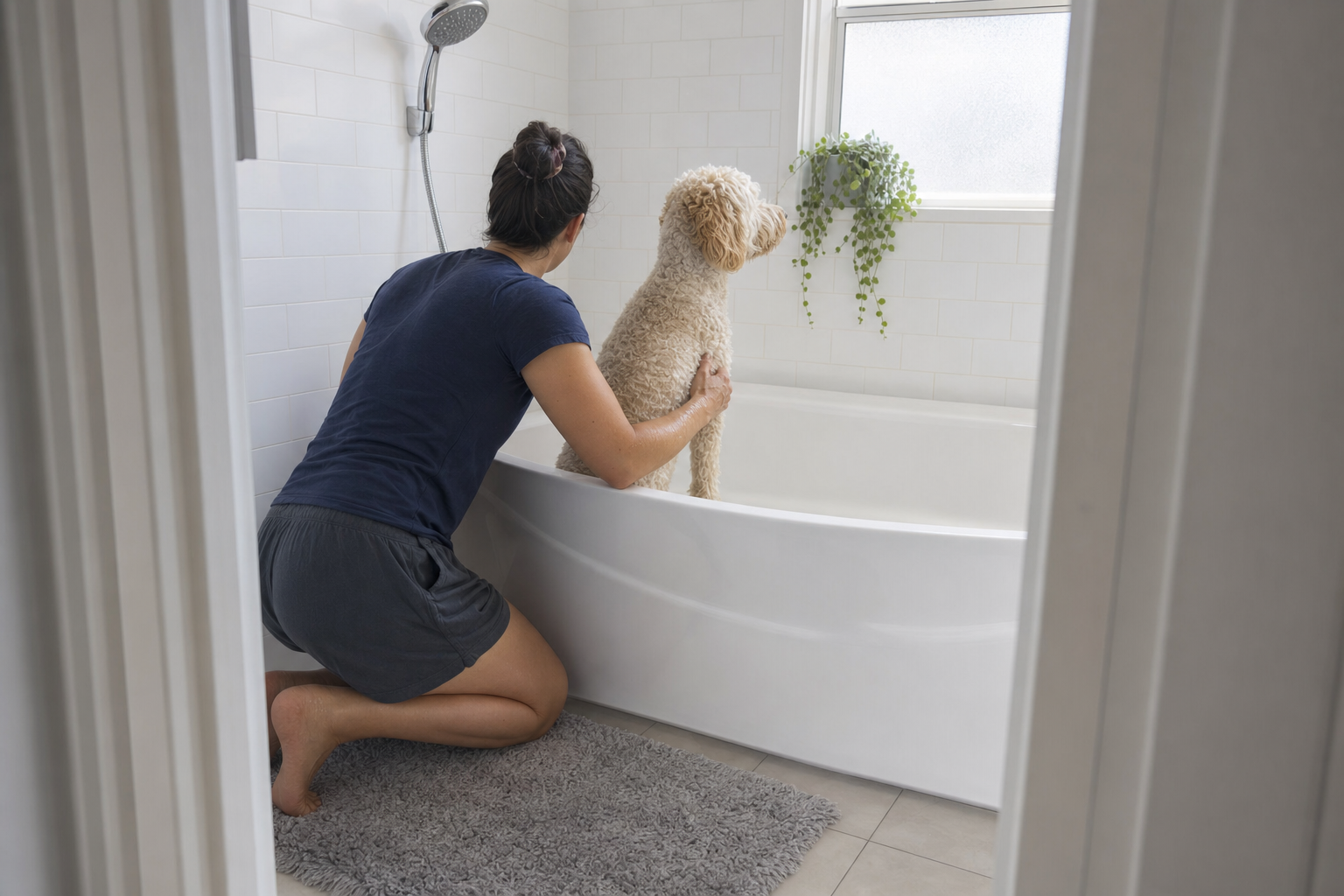
It is possible to groom a large dog at home, however, it requires a lot of preparation. Do you have a bathtub or shower large enough? Will your plumbing take the quantity of fur that falls off? Do you have a secure place where the dog can be kept?
Washing a big dog is not a problem to many owners, but drying is the challenge. Human hair dryers are not that powerful, as they are usually too hot to dry a dense coat safely. You should invest in a pet specific force dryer in case you intend to do this on a regular basis. Also, moving a big, wet, and thus uncontrollable dog may be physically challenging.
When should I seek professional help?
No matter the size of the dog, there are times when professional intervention is the safest choice.
- Severe Matting: If you cannot get a comb through the hair, do not try to cut the mat out with scissors. You risk cutting the skin. The mat can be shaved by a professional without any harm.
- Behavioral Problems:
When a dog gets aggressive or very scared when it is being groomed, a professional has the training and equipment to deal with such a situation safely.
- Specialty Styling:
In case you desire a certain breed cut (such as Schnauzer cut or
Poodle clip), a professional groomer can make the style work out right.
- Anal Gland Expression:
Although some owners get to learn, it is a task most probably left to professionals to prevent infection or impaction.
Keep your dog healthy with the right care
Your teacup friend or your big dog, it does not matter, constant grooming is crucial to their well-being. It prevents painful mats, skin infections and overgrown nails that may affect mobility. Being aware of the individual needs of your dog, depending on the size and the type of coat will help to make sure that it remains comfortable, healthy, and happy.
When you are not sure of the most suitable tools or timing of your pet or when the physical requirements of grooming are becoming overwhelming, then our team can assist. Ready to give your pet the best spa day?
Book a professional grooming session with us today.