
Dog Grooming in Mechanicsburg, PA: What the Mobile Van Setting Does for Anxious and Senior Dogs
How mobile dog grooming in Mechanicsburg, PA changes the experience for anxious, reactive, and senior dogs. What we do differently and why it works.
Cattle dog named Ruthie had been groomed exactly twice in four years. First time, the shop called her owner to come early because Ruthie had worked herself into a full shutdown, panting, shaking, refusing to eat or drink. Second time, her owner dropped her off and sat in the parking lot for two hours unable to leave. The third time was in a mobile van. Ruthie finished in fifty minutes and ate her treat on the way back down the ramp.
Quick answer: Dog grooming in Mechanicsburg, PA through a mobile van means your dog is the only animal on the van during their appointment. No waiting kennel, no barking from other dogs, no drop-off delay. For anxious, reactive, or senior dogs, this single change makes a measurable difference in how the session goes.
What a Dog That Is Stressed in a Shop Looks Like in the Van
In a shop, stress builds from the moment of drop-off. The dog smells dozens of other animals, hears dryers and other dogs at the same time, goes into a kennel to wait, and then comes out to a stranger in a new location. By the time grooming starts, the anxiety budget is already spent. That is when you get the shaking, the mouth-breathing, the refusal to stand still.
In a mobile van, the dog goes from its own yard directly into a small enclosed space with one person. There is no kennel phase. The groomer moves from greeting to bath in a few minutes. For dogs that are scent-triggered, the van does not carry the smell of other animals the way a shop does. For sound-sensitive dogs, the only unfamiliar noise is the high-velocity dryer, and we introduce that gradually.
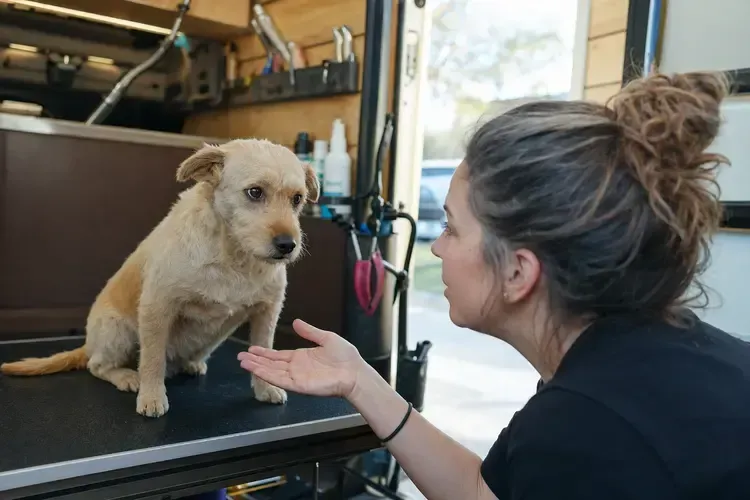
Three Behaviors That Tell Us a Dog Needs Extra Time
- Whale eye (whites visible) combined with a rigid body means the dog is at threshold. Slow down and give a two-minute break.
- Repeated lip-licking or yawning when not tired are classic calming signals. The environment is overwhelming.
- A sudden freeze or full-body stiffness means stop what we are doing, remove pressure, and let the dog reset before continuing.
None of these mean the session has to stop completely. They mean we adjust. Slower movement. Lower dryer setting for a few minutes. A short break with the dog standing quietly. Most anxious dogs in a mobile van start at a lower stress baseline than in a shop, so they have more room before hitting these signals. We watch for them every session regardless.
Senior Dogs in Mechanicsburg: Why Shorter Sessions Matter
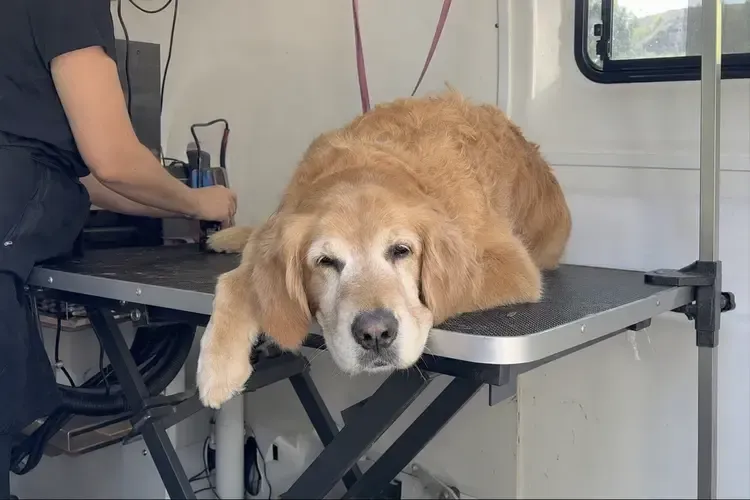
A dog over nine or ten years old is not physically the same as a six-year-old. Standing on a grooming table for ninety minutes is genuinely tiring. Joints that are stiff or arthritic make it harder to hold positions during nail work or the drying stage. Older dogs also fatigue faster under stress, so a mobile session's shorter overall timeline is not just emotionally easier, it is physically easier too.
We break senior sessions up when needed. If a dog needs to lie down mid-groom, we work around it. If a dog struggles to stand on the table, we can do parts of the groom on a mat on the van floor. The hydraulic table adjusts all the way down to minimize how much the dog has to hold itself up. None of this costs extra time in a mobile setting the way it would in a busy shop with a full queue behind it.
What We Do Differently When a Dog Is Reactive
The mobile grooming for reactive dogs setup differs from a standard appointment. We ask for more detail in the intake form: what triggers the dog, whether the dog has ever redirected onto a groomer, and what works to de-escalate. We also do not double-book reactive dogs back to back on the same route day. They get a buffer slot so there is no time pressure on the groomer.
For
mobile pet grooming Mechanicsburg, reactive dog appointments are available on most route days. We do not require a muzzle as a condition of booking, though we may use one during certain steps if the groomer assesses it is the safest option. We communicate that before the next appointment.
Booking Differences for Anxious vs Standard Dogs
| Step | Standard booking | Anxious or reactive dog booking |
|---|---|---|
| Intake form | Size, breed, coat notes | Triggers, past incidents, what calms the dog |
| First appointment | Bath or full groom by coat type | Bath package to start, low-stress introduction |
| Session pacing | One dog, one groomer, no queue | Same, plus breaks built in as needed |
| Dryer introduction | Standard high-velocity dry | Slower start, greater distance at first |
| Follow-up | Standard rebook | Notes carried forward every visit |
For a first visit with an anxious dog, we recommend starting with the bath package rather than a full groom. It is shorter, has fewer steps, and lets the dog get used to the van without the added complexity of a haircut. If the bath goes well, the next appointment can add the full groom. That graduated approach tends to produce better results than trying to do everything on the first visit.
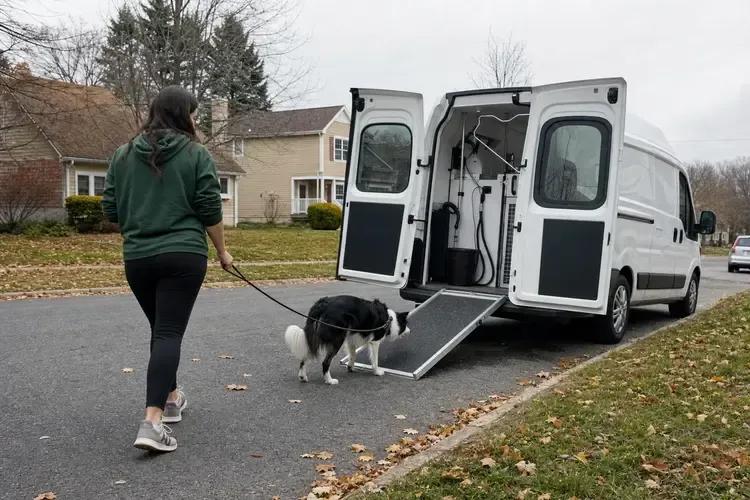
Ruthie, the cattle dog, is now every-eight-weeks regular. She still needs a longer introduction than most dogs. She still watches the dryer with some suspicion when it first starts. But she eats the treat on the ramp every single time, which is more than she was doing in the parking lot of that shop.